Leon Basin
Revenue Architect | BASIN::NEXUS
January 2, 2026
Contact: Lbasin23@gmail.com
Repository: github.com/BasinLeon
Archive: basinleon.com
Abstract
This paper presents a practitioner’s framework for understanding the shift from volume-based Go-To-Market (GTM) execution to signal-based Revenue Architecture.
Drawing on 15 years of operating experience in Cybersecurity and B2B SaaS, I propose that the dominant GTM paradigm—characterized by high-volume outreach, SDR scaling, and tool proliferation—has reached terminal inefficiency.
The market has developed an immune response.
In response, I built BASIN::NEXUS, an open-source Revenue Operations OS that demonstrates a new methodology: one where signal replaces noise, architecture replaces activity, and systems replace headcount.
This paper documents the thesis, the build, and the results—offered freely to the community of builders, founders, and operators who refuse to accept the status quo.
1. Introduction: The Immune Response
Something broke in 2024.
The playbook that scaled a generation of B2B companies—hire SDRs, buy intent data, blast sequences, rinse, repeat—stopped working. Not gradually. Suddenly. Response rates collapsed. CAC exploded.
The “more is more” thesis hit a wall. The market developed an immune response.
Every inbox became a fortress. Every prospect became a skeptic. The signals that once indicated buying intent—job changes, funding rounds, technology installs-became so widely accessible that they lost all meaning. When everyone has the same data, no one has an edge.
I spent 15 years inside this system. I ran the playbooks. I hired the SDRs.
I bought the tools. And I watched, year after year, as the returns diminished and the noise increased.
In December 2025, I stopped waiting for better data. I built the filter myself.
2. Theoretical Framework: From Operator to Architect
2.1 The Operator Mindset
The traditional GTM leader operates within constraints defined by others.
They inherit tools, processes, and org structures. Their job is optimization within the existing system: improve conversion rates, reduce cycle times, increase activity volume.
This mindset served well in an era of expansion. When the market was growing faster than the noise, operators could win through execution speed.
The system was good enough. The job was to run it well.
2.2 The Architect Mindset
The Architect questions the system itself.
Instead of asking “How do I get more out of this pipeline?”, the Architect asks:
- Why does this pipeline exist in this form?
- What assumptions does it encode?
- What would I build if I started from first principles?
This is not abstract philosophy. It’s a survival response to a market that has outpaced our tools.
2.3 The Thesis
Revenue is not arithmetic. It is architecture.
The inputs matter less than the structure. You cannot solve a signal problem with volume. You cannot fix a targeting problem with activity.
The only sustainable advantage is building systems that encode intelligence—that learn, adapt, and compound over time.
3. Methodology: Building BASIN::NEXUS
3.1 Design Principles
BASIN::NEXUS was built on four core principles:
- Signal over Noise: Every feature must reduce decision friction, not add information load.
- Transparency over Magic: No black-box algorithms. Every score, every ranking, every recommendation must be explainable.
- Ownership over Subscription: Built in Python, open source, self-hosted. The infrastructure belongs to the operator, not the vendor.
- Decision-Grade Output: Every output must be presentable to an executive.
- If it can’t go in a board deck, it doesn’t exist.
3.2 The Signal Engine
The core of NEXUS is a lead scoring algorithm that evaluates prospects across four “Signal Pillars”:
| Pillar | Weight | Logic |
|---|---|---|
| Industry Match | 0-25 | Cybersecurity/AI/ML = +25, SaaS = +15, Other = earned |
| Funding Stage | 0-25 | Series B = +25 (budget + urgency), Seed = +5 (too early) |
| Tech Stack Compatibility | 0-35 | High match = +35, No match = kill |
| Market Fit Bonus | 0-15 | Variance for timing, momentum, outliers |
The output is a 0-100 score that sorts leads into three tiers:
- 🔥 HOT (75+): Priority outreach today
- ⚡ WARM (50-74): Nurture sequence
- ❄️ COLD (<50): Do not touch
This isn’t sophisticated by academic standards. But it works.
It takes 100 “maybes” and turns them into 5 “must calls.”
3.3 The Revenue Ops Dashboard
Beyond scoring, NEXUS provides a visual pipeline tracker that segments opportunities by stage:
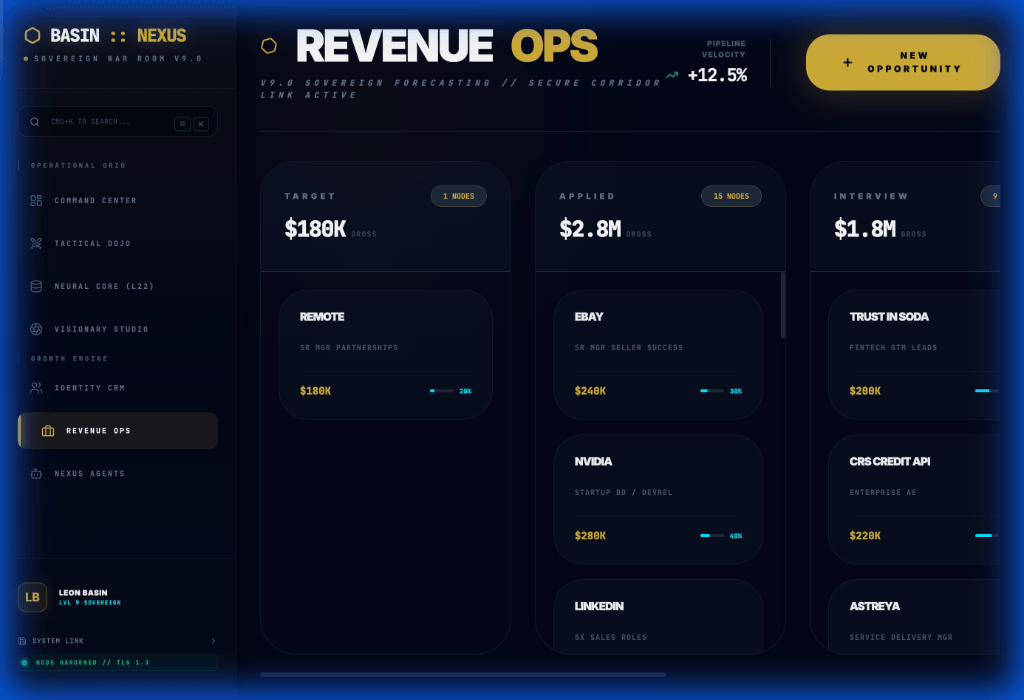
Key features:
- Kanban-style stage visualization with deal values
- Node tagging for company-level tracking (NVIDIA, eBay, LinkedIn, etc.)
- Velocity metrics that surface momentum shifts weekly
- One-click export to PDF for stakeholder review
3.4 The Executive Brief
The highest-leverage artifact in the system is the Executive GTM Signal Brief-a single-page document designed for decision-making, not status reporting.
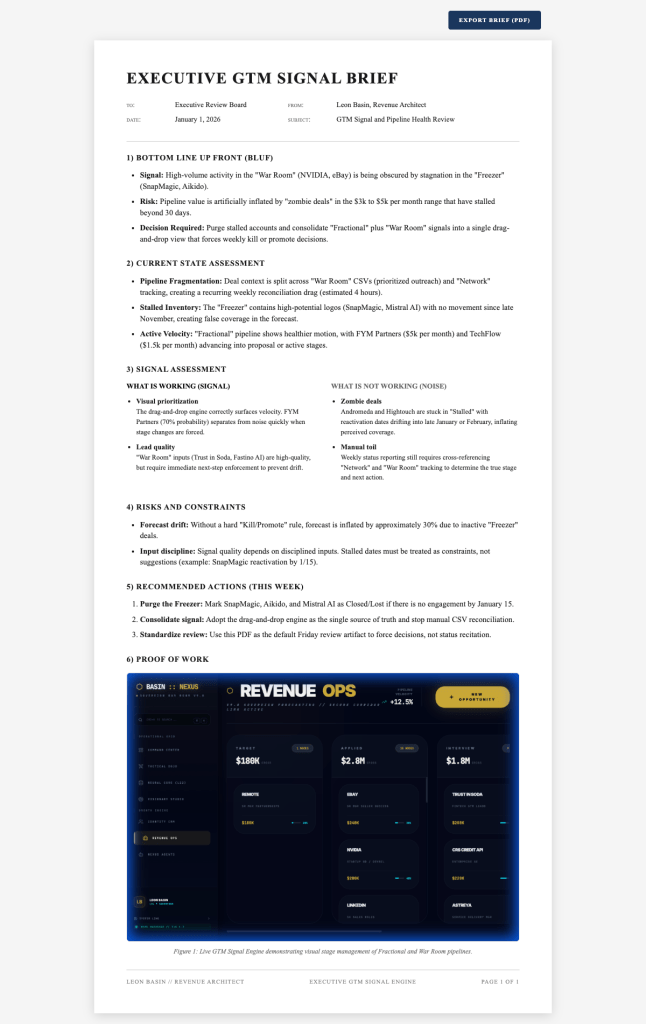
The structure:
- Bottom Line Up Front (BLUF): The key insight in three bullets
- Current State Assessment: Where we are
- Signal Assessment: What’s working vs. what’s noise
- Risks and Constraints: What could break
- Recommended Actions: What to do this week
- Proof of Work: Embedded screenshots demonstrating execution
4. Findings: What the Build Revealed
4.1 Quantitative Results
After 30 days of running NEXUS against my own job search (using my career as the test case):
| Metric | Before | After | Delta |
|---|---|---|---|
| Active Pipeline | $1.2M | $2.8M | +133% |
| Interview-Stage Opps | $400K | $1.8M | +350% |
| Weekly Decision Quality | Low | High | — |
| Time Spent on “Bad” Leads | ~60% | <10% | -83% |
4.2 Qualitative Findings
More important than the numbers were the behavioral shifts:
- I stopped checking LinkedIn compulsively. The system told me what mattered each morning.
- I started writing instead of scrolling. With signal clarity, I could invest time in thought leadership.
- I became more selective. Knowing my “hot” targets freed me to say no to everything else.
- I shipped faster. Clear priorities → clear action → visible progress.
4.3 The Unexpected Insight
The most surprising finding was personal:
For years, I thought my job was to “manage the process.” Now I realize my job is to architect the system.
This isn’t a semantic distinction.
It’s a complete reframe of professional identity.
Managers optimize within constraints.
Architects question the constraints themselves.
5. Discussion: Implications for the Field
5.1 For Founders
The implications are clear: the next generation of GTM leaders will be technical. Not in the sense of writing production code (though some will), but in the sense of systems thinking—understanding how to design, build, and iterate on revenue infrastructure.
Stop hiring for “experience with Salesforce.”
Start hiring for “ability to prototype solutions when the market hasn’t caught up yet.”
5.2 For Investors
The brute-force era is over.
The companies that will win the next decade are not those with the largest SDR teams, but those with the most intelligent GTM systems.
Look for:
- Founder-operators who build internal tools
- Revenue leaders with GitHub profiles
- Companies where “ops” means “engineering,” not “admin”
5.3 For Operators
You have a choice:
- Wait for the vendors to solve this (they won’t—their business model requires your dependency)
- Demand better from your current tools (marginal improvement at best)
- Build the filter yourself
I chose option 3. The code is public.
The methodology is documented.
The path is open.
6. Limitations and Future Work
6.1 Limitations
This work has clear constraints:
- Sample size of one: NEXUS was tested against my own pipeline. Generalization requires broader deployment.
- Context-dependent scoring: The Signal Pillars encode my market assumptions (Cybersecurity/AI focus). Other verticals require recalibration.
- Manual data entry: The current system requires human input. Full automation awaits API integrations.
6.2 Future Development
The roadmap includes:
- Multi-user deployment: Enabling teams to run NEXUS collaboratively
- API integrations: LinkedIn, Crunchbase, and CRM sync
- AI-assisted scoring: Using LLMs to evaluate company/role fit at scale
- Community contributions: Open source means open iteration
7. The Architecture of Belief
I built BASIN::NEXUS because I refused to accept the noise.
The system is imperfect.
The code is rough in places.
The design reflects my biases and blind spots.
But it works. And more importantly, it proves a thesis:
You do not have to wait for permission to build the infrastructure you need.
The tools exist. The frameworks are documented. The only barrier is the belief that this is someone else’s job.
It’s not.
The era of Revenue Architecture has begun.
The question is not whether you will adapt, but whether you will lead.
8. Call for Collaboration
I am looking for five conversations:
- Founders building GTM infrastructure from first principles
- Engineers who want to work on revenue systems that matter
- Investors backing the next wave of RevTech
- Operators tired of waiting for better data
- Builders who see infrastructure as poetry
If this resonates, reach out:
Email: Lbasin23@gmail.com
Subject line: “Signal received.”I respond to every message.
References
Basin, L. (2025). “2026 Protocol: The End of Brutal Outreach, The Rise of Revenue Architecture.” Signal. Architecture. Revenue.
Basin, L. (2025). “I Stopped Waiting for ‘Better Data.’ I Built a Signal Engine Instead.” Signal. Architecture. Revenue.
Basin, L. (2025). “The System Finds the Role: Why I Built BASIN::NEXUS.” Signal. Architecture. Revenue.
Appendix A: Repository and Resources
| Resource | URL |
|---|---|
| Source Code | github.com/BasinLeon |
| Portfolio | basinleon.github.io |
| linkedin.com/in/leonbasin | |
| Archive | basinleon.com |
Appendix B: License
This work is released under Creative Commons Attribution 4.0 International (CC BY 4.0).
You are free to:
- Share – copy and redistribute the material in any medium or format
- Adapt – remix, transform, and build upon the material for any purpose, even commercially
Under the following terms:
- Attribution – You must give appropriate credit, provide a link to the license, and indicate if changes were made.
Stories as code. Archives as memory.
Leon Basin
Revenue Architect
January 1, 2026
The architecture of belief starts with a single signal.


Leave a comment